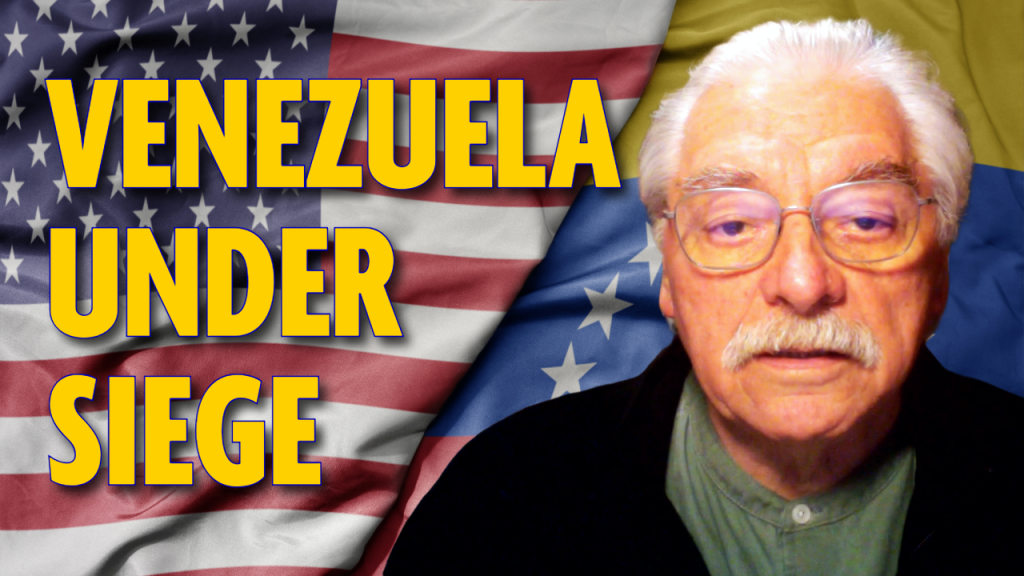
VSC Secretary Francisco Dominguez outlines the current situation in Venezuela amid unprecedented US aggression and threats, and the priorities for the solidarity movements in Western countries.
Based on the article: Venezuela Under Siege: Defending the Bolivarian Revolution Against US Imperialism by Francisco Dominguez and Roger D. Harris
TRANSCRIPT
The US military attack against Venezuela that led to the abduction of President Maduro and National Assembly member and first combatant Celia Flores on the third of January twenty twenty six, has not only created a thoroughly unprecedented situation, it did not lead to regime change, but also to some confusion among international supporters of the Bolivarian Revolution.
Though the Bolivarian state is intact and the forces that support it are united, the threat of military attack and further decapitation, that is to say, assassination of the Chavista leadership is omnipresent, regularly repeated and explicit. The imperialist military siege is asphyxiatingly present and the overwhelming structure of US hybrid warfare against Venezuela remains intact, continuing to suffocate the country’s economic recovery and undermine its sovereignty.
Washington is exerting oppressive pressure over Venezuela’s oil industry, its main foreign revenue earner, through sanctions, financial coercion and domination of the world financial system. This despite the U.S. “normalization” of relations with Venezuela and the Trump administration’s recognition of Delcy Rodriguez’ government, the Delcy Rodriguez government that finds itself with a metaphorical U.S. gun pointed to his head has clearly been coerced to adopt a number of decisions and accept compromises that may have or will have, negative consequences.
It is crucial that we in the international solidarity movement focus vigorously and unequivocally on opposing US imperialist aggression and not seek to adjudicate every tactical decision made under such conditions by the Delcy Rodriguez government. This is especially important since the US is simultaneously waging disinformation campaigns against the Chavista leadership, the Cuban Revolution and all progressive forces in Latin America.
This takes us to our responsibilities. All this means that any discussion of the bad consequences of coerced decisions should be understood within the context of relentless US aggression, destabilization efforts, and military threats. Furthermore, support for Bolivarian Venezuela against US imperialist aggression does not require agreement with every decision taken under conditions of coercion. This includes the decision to deport Alex Saab. In this regard, we must be aware that a long standing objective of US imperialism has been to fracture the unity of the Chavista leadership, the military and its popular base.
Despite all that has happened and the immense pressure, the unity of Chavismo, the government, the military and the popular base has held. Therefore, attempts to counterpose solidarity with the popular base against solidarity with the leadership, no matter how well intentioned, objectively aid and strengthen imperialist aims. The political choices made by the Chavista leadership must be resolved in Venezuela.
The role of internationalists is to oppose US imperialism and imperialist forces at home, not to instruct Venezuelans on how to defend their revolution. We do not know the full extent of the pressures exerted on the Venezuelan government, nor the range of alternatives realistically available under present conditions. The Venezuelan leadership operates under severe geopolitical constraints. The US openly threatens Libyan or Iranian style retaliation. Another major military escalation remains entirely possible. Compared to the height of the pink tide period, the regional relation of forces have substantially deteriorated and Venezuela today lacks strong regional allies, while in the context of the intensified aggressiveness of US foreign policy, International law offers little meaningful restraint on US power.
Given the massive military asymmetry between the two countries, the consequences of direct military confrontation would be catastrophic for Venezuela, potentially including the destruction of vital infrastructure and long term devastation of the oil industry upon which the country heavily depends. If the U.S. succeeds in placing the extreme right wing opposition in power, the likely result will be devastating political repression directed against Chavismo and the most vulnerable sections of society.
While continuing to rely upon the Chavista base, the government also recognizes the necessity of building a broad, patriotic bloc capable of resisting imperialist pressure more effectively, even amid forced compromises. The central achievements of the Bolivarian process remain significant: preservation of the revolutionary leadership, survival against destabilization efforts, and avoidance of a full scale invasion.
Years of sanctions and economic warfare severely degraded Venezuela’s oil infrastructure. Restoring productive capacity, re-establishing trade, and attracting investment have therefore become vital imperatives. The political transitions from Chavez to Maduro to Rodriguez largely reflect changes in the international geopolitical landscape. Yet there has remained substantial political continuity within Chavismo, evident in continued solidarity with Cuba, the vitality of the communal system, and the endurance of the revolutionary mass movement. Venezuela’s solidarity with Cuba despite U.S. restrictions on oil shipments, has led to the setting up in Venezuela of the national campaign: “love is paid with love” aimed at collecting medicines, health input, medical equipment and all donations to purchase solar panels to be installed in hospitals, schools and laboratories, and non-perishable foodstuffs. Several shipments of these items have been sent to Cuba already.
In conclusion, under conditions of economic warfare, military threat, diplomatic isolation and perpetual destabilisation efforts, Venezuela’s contradictions cannot be analyzed abstractly or outside the realities of imperialist power. The primary task of solidarity movements within the imperial centers remains, but has always been opposing the aggression of our own ruling class. All support in solidarity with the Bolivarian Revolution.