
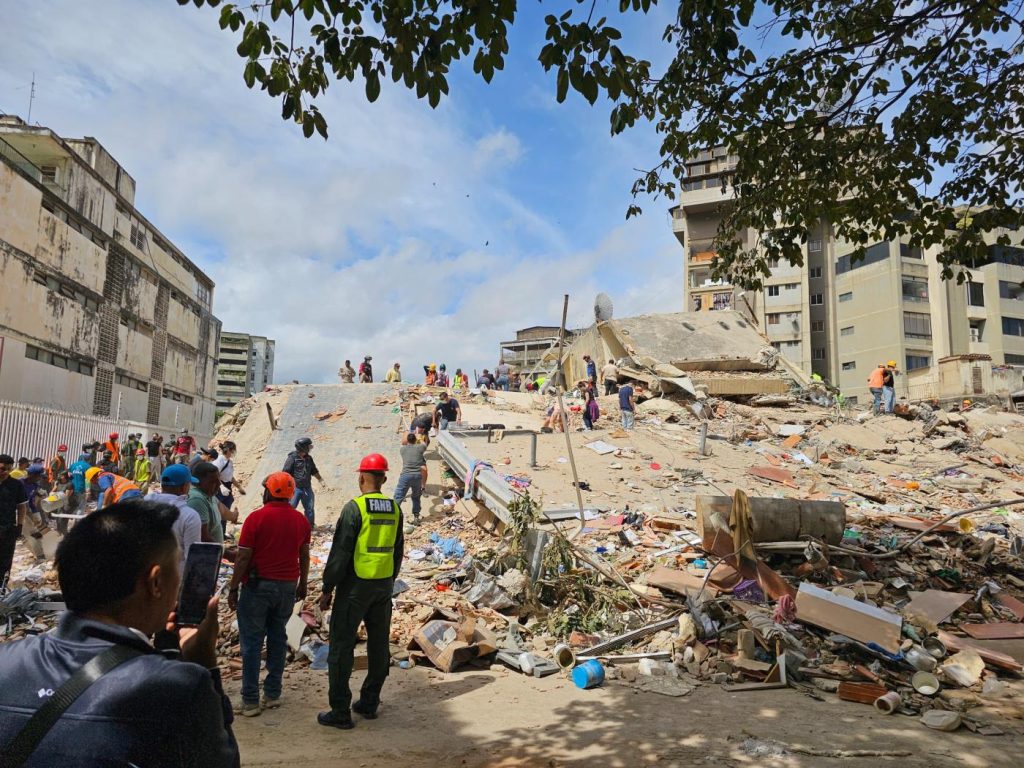
Over 100 economists from around the world have written an open letter calling on the U.S. treasury to lift sanctions on Venezuela to aid earthquake recovery efforts, two weeks after the country’s most powerful earthquakes in over a century.
The signatories, whose institutions range from Columbia, UMass Amherst, Cambridge, and the CEPR, call on the US Treasury to lift broad sanctions on Venezuela’s central bank, PDVSA, and related sectors, and to issue the certification needed for the BCV to operate through US banks. They also urge the UK to unfreeze around 30 tons of gold reserves, and Portugal to return $1.2 billion held in a development bank account.
They request Venezuela have full access to $5 billion in Special Drawing Rights at the IMF and an unconditional $4 billion emergency loan. They further ask official and multilateral creditors to suspend or cancel debt payments, freeing up funds for hospitals, water systems, and power grids.
If acted upon, these measures could unlock billions in frozen reserves, significantly aiding the reconstruction of Venezuela and increasing Venezuelans’ access to food, medicine and rebuilding materials.
The letter is reproduced below
July 7, 2026
We, the undersigned economists and related scholars, write in response to the devastating earthquakes that struck Venezuela on June 24, 2026. These disasters—the most powerful earthquakes to hit the country in over a century—collapsed countless homes and businesses, severely damaged essential infrastructure, and have left hundreds dead or missing, and many more injured. It may take years to rebuild.
The emergency is human before it is political. Rescue, shelter, hospitals, water, power, transport, food and medicines cannot wait for diplomatic bargaining, creditor committees, or sanctions paperwork. Every hour of delay transforms a natural disaster into an avoidable social catastrophe. We therefore urge immediate action to unfetter Venezuela’s humanitarian response and reconstruction from ongoing economic and financial sanctions, asset freezes, and onerous debt burdens.
Venezuela enters this disaster after years of unilateral coercive measures, financial sanctions, and export controls that have damaged its economy and infrastructure. Whatever one’s position on Venezuela’s internal politics, the current set of coercive economic measures directed at the country is an indiscriminate instrument. Sanctions on the central bank, public banking, oil industry, and debt transactions do not land surgically on officials; they incapacitate payment systems, raise import costs, block correspondent banking, freeze reserves, deter suppliers, and produce scarcity across an entire society. This is precisely the moment to remove any economic and financial obstacles to relief and reconstruction.
We therefore call on the US Department of Treasury to lift all broad economic sanctions on Venezuela, including any that may impact the Banco Central de Venezuela (BCV), government institutions, Petróleos de Venezuela, S.A. (PDVSA), public financial institutions, the oil and mining sectors, banking, transportation, shipping, telecommunications, travel, and all related activities. Existing licenses are not enough if Venezuela’s own resources remain blocked, banks fear secondary sanctions, and vendors cannot be certain they will be paid. This should be paired with the immediate issuance of the Section 25B certification that is required to enable the BCV to receive, control, use, and transact through its accounts and assets at the Federal Reserve and US banks.
In addition, we urge the government of the United Kingdom to work with the Bank of England to ensure the immediate unfreezing of the BCV’s gold reserves, worth about $5 billion and representing a third of the central bank’s reported assets. We also urge the Portuguese government to work with Novo Banco to return $1.2 billion belonging to Venezuela’s development bank, BANDES, and PDVSA affiliates, as set out in a 2023 court decision. These frozen funds rightfully belonging to Venezuelan institutions are crucial in enabling the state’s response to the crisis and stabilizing the balance of payments.
We further call on the International Monetary Fund and its major shareholders to restore Venezuela’s practical access to the Fund. The IMF should ensure that Venezuela has full access to its approximately $5 billion in Special Drawing Rights (SDRs) for emergency stabilization and imports. SDRs are the most direct, least burdensome source of liquidity available: they add to reserves, help stabilize payments, and can be exchanged for hard currency to finance food, medicine, water systems, fuel, shelter, and power-grid repair.
The IMF should also approve a $4 billion Rapid Financing Instrument (RFI) disbursement immediately, using its emergency and natural disaster rationale, with no conditions. The RFI exists for urgent balance-of-payments needs when a full program is neither necessary nor feasible. In the wake of an earthquake, conditionality that delays procurement or forces cuts to public spending is economically perverse and morally indefensible.
Finally, we call for a coordinated debt jubilee for Venezuela. All official bilateral creditors, multilateral creditors to the extent legally possible, and public agencies holding claims should cancel or suspend debt service, interest, penalties, and arrears, and pursue a comprehensive debt reduction consistent with a rights-based recovery and climate-resilient reconstruction. A new fund should be established—perhaps financed by the IMF’s Resilience and Sustainability Trust (RST)—to repurchase distressed debt from the secondary market, with legal protections against holdout litigation and asset seizures. Money owed to creditors cannot at the same time rebuild hospitals, schools, housing, water systems, and the grid. A debt crisis in these conditions is a developmental and humanitarian crisis.
Venezuela’s people must not be made to pay twice: first through disaster, and then through sanctions, frozen reserves, and unsustainable debt servicing. We urge governments, international financial institutions, and creditors to act now, on the principle that lives, public health, and economic recovery take precedence over coercion and collection. Emergency liquidity, full sanctions relief, SDR access, RFI financing, and debt cancellation are not acts of charity. They are the minimum policy response required to prevent avoidable deaths, stabilize a sanctioned economy, and allow Venezuelans to rebuild with dignity.
Over 100 Signatories including: (titles and affiliations are included for identification purposes only)
Francisco Rodriguez, University of Denver
Andrés Arauz, former director of the Central Bank of Ecuador, Center for Economic and Policy Research
Mark Weisbrot, Co-Director, Center for Economic and Policy Research
Jayati Ghosh, UMass Amherst
Isabella Weber, Associate Professor of Economics, University of Massachusetts Amherst
Jeffrey Sachs, University Professor, Columbia University
James K. Galbraith, Trustee and former Chair, Economists for Peace and Security
Adriana Abdenur, Sociologist, Global Fund for a New Economy
Ilias Alami, Assistant Professor in Political Economy, University of Cambridge
Mona Ali, Associate Professor of Economics, State University of New York
Carolina Alves, University College London, IIPP
Michael Ash, Professor of Economics and Public Policy, University of Massachusetts Amherst
Venkatesh Athreya, Professor of Economics (Retired), Adjunct Professor, Asian College of Journalism
Dean Baker, Distinguished Senior Fellow, CEPR
Magdalena Bas, Associate Professor of International Law, University of the Republic
Günseli Berik, Professor Emerita of Economics, University of Utah
Peter Bohmer, Professor of economics emeritus, The Evergreen State College
Jim Campen, Professor of Economics, Emeritus University of Massachusetts Boston
Kevin Cashman, Researcher, Transition Security Project